How to read your Lippert (LCI) axle label
That row of letters and numbers on your axle tag tells you the exact brakes, bearings, springs, and bolt pattern you have. Here is how to decode a Lippert (LCI) axle label, one block at a time.
Every Lippert (LCI) spring axle carries a metal ID label, and once you can read it you can order the exact right brakes, bearings, seals, springs, and hubs without guessing or pulling parts off to measure them. The label looks like a jumble of letters and numbers, but it is really just a string of shorthand codes stacked together. Here is how to break it down, in plain terms.
Lippert also builds axles under the CURT name. Those read the same way, except the model code starts with CURT instead of LCI (for example CURT52 in place of LCI52).
What is on the label
Before the long description code, the label spells out a few things on its own:
- Part number or variant number. The number you order by. A part number is a standard build; a variant number (it starts with a V) is a more custom configuration.
- Axle description. The long code we decode below. It packs in everything about the axle.
- Axle capacity. Rated off the lowest-rated component Lippert put on the assembly, and it does not include your tires and wheels. Your trailer's actual GAWR (gross axle weight rating) is set by the trailer manufacturer and printed on the trailer's VIN label, so always defer to that for what the axle is allowed to carry on your trailer.
- Date of manufacture and RPO number (the production run the axle came from).
- CSA/QAI approval. If the axle is certified, a QAI logo sits in the upper right corner of the label.
Reading the axle description code
The whole thing is read left to right, one section at a time. Lippert's own example is a good one to follow:
LCI52-SBSA-86.5-68.5-NOSP-OS-L-65517-7225-30PT
Piece by piece that is: a 5,200 lb model, straight spindle with self-adjusting electric drum brakes, an 86.5" hub face, 68.5" spring centers, no shock plate, springs over the tube, super-lube, a 6-on-5.5" hub for 12" x 2" brakes, 2,600 lb springs, and a 30" wiring pigtail. Below is what each block means.
1. Model and capacity
The first block sets the axle's family and its rated capacity and brake size.
| Model | Capacity | Standard electric brake |
|---|---|---|
LCI20 | 1,000 - 2,000 lbs | 7" x 1.5" |
LCI35 | 2,500 - 3,500 lbs | 10" x 2.25" |
LCI44 | 4,000 - 4,400 lbs | 10" x 2.25" HD |
LCI52 | 4,000 - 5,200 lbs | 12" x 2" |
LCI60 / LCI60MH | 6,000 lbs | 12" x 2" |
LCI70 / LCI70MH | 7,000 lbs | 12" x 2" |
LCI80H | 8,000 lbs | 12" x 2" |
LCI80 | 8,000 lbs | 12.25" x 3.38" |
LCI100 / LCI100S | 10,000 lbs | 12.25" x 3.38" |
LCI120 | 12,000 lbs | 12.25" x 5.00" |
LCI160 | 16,000 lbs | 12.25" x 5.00" |
2. Spindle and brake
The second block is the spindle type and what brake (if any) rides on it. "Straight" spindles sit inline; "drop" spindles lower the trailer. "Idler" means no brake at all.
| Code | Meaning |
|---|---|
SB | Straight spindle, electric drum brake |
SBSA | Straight spindle, electric drum brake, self-adjusting |
SBSALL | As SBSA, with 33" lead wires |
SI | Straight spindle, idler hub, no brake |
SINF | Straight spindle, idler, no brake and no brake flange |
SBWP | Straight spindle, electric drum brake with park feature |
DB | Drop spindle, electric drum brake |
DBSA | Drop spindle, electric drum brake, self-adjusting |
DI | Drop spindle, idler hub, no brake |
SHUS / SHDS | Straight spindle, hydraulic uni-servo / duo-servo drum brake |
SHUSFB | Straight spindle, hydraulic uni-servo free-backing drum brake |
SAB | Straight spindle, air brake |
SD / DD | Straight / drop spindle with hydraulic disc brake |
3. Hub face and spring centers
The two numbers after the spindle code are dimensions, in inches. The first is the hub face (also called "hub face to hub face"): the distance between the wheel mounting surfaces on the two hubs. The second is the spring center: the distance between the spring seats. These are customer-specified when the axle is built, so they vary trailer to trailer. A code of NOSS in the spring-center slot means no spring seats were welded on.
4. Tie plate and spring mounting
The tie-plate code tells you how the springs attach and whether shock mounts are welded on.
| Code | Meaning |
|---|---|
SPIB | Shock plate for inboard shocks |
SPOB | Shock plate for outboard shocks |
NOSP | No shock plate, regular tie plate |
FIXSS | Fixed spring seats both sides at a standard width |
ADJSS | One fixed, one adjustable spring seat (10K, 12K, 16K) |
HUTSS | Hutch spring seat welded (12K, 16K) |
The next code is how the springs sit relative to the tube:
| Code | Meaning |
|---|---|
OS | Overslung: springs mounted on top of the axle tube |
US | Underslung: springs mounted beneath the axle tube |
NOSS | No spring seat |
5. Lubrication
How the bearings are greased or oiled. This matters when you service the hubs.
| Code | Meaning |
|---|---|
L | Super-lube: grease zerk in the spindle end, dust cap with rubber plug (standard on LCI20 through LCI80/80H) |
G | Standard grease: solid dust cap, no zerk (optional on all axles) |
O | Oil lubrication (optional on LCI80/80H, standard on 10K to 16K axles) |
6. Hub and bolt pattern
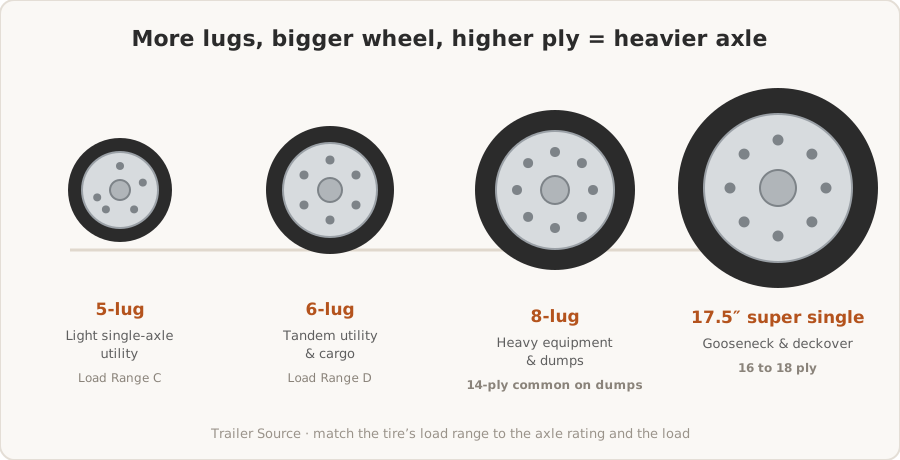
This is the block most people actually need, because it is your bolt pattern (how many lug bolts and the circle they sit on) and it tells you which brake or hub the axle uses. The pattern reads as bolts-on-circle: for example 65517 is 6 bolts on a 5.5" circle. A leading C means a CURT hub.
| Code | Bolt pattern | Typical brake / hub |
|---|---|---|
440 | 4 on 4.00", 1/2-20 stud | Idler |
545/5.5 | 5 on 4.50", 5.5" hub face (10" wheels and under) | Idler |
545/6.5 | 5 on 4.50", 6.5" hub face (12" wheels and up) | Idler |
545/7 | 5 on 4.50" | 7" x 1.25" brake |
545 | 5 on 4.50" | 10" x 2.25" brake, disc, or idler |
5475 | 5 on 4.75" | 10" x 2.25" brake or idler |
550 | 5 on 5.00" | 10" x 2.25" brake or idler |
555 | 5 on 5.50" | 10" x 2.25" brake or idler |
655 | 6 on 5.50" | 10" x 2.25" brake, disc, or idler |
65517 | 6 on 5.50" | 12" x 2" brake, disc, or idler |
86517 | 8 on 6.50", 1/2-20 stud | 12" x 2" brake, disc, or idler |
865 | 8 on 6.50", 5/8-18 stud | 12.25" x 3.38" or 12.25" x 5" brake, or disc |
8/275 | 8 on 275mm, M22 stud | 12.25" x 5" brake or disc |
If ABS follows the hub code, the axle has an ABS sensor and tone ring.
7. Leaf springs
Near the end, a spring code sets the spring's rated capacity, length, and number of leaves. Lippert uses a long list of double-eye and slipper spring codes; a few of the common ones:
| Code | Capacity | Leaves | Length |
|---|---|---|---|
7217 | 1,000 lbs | 3 | 20 3/8" |
7206 | 1,250 lbs | 3 | 23 1/8" |
7209 | 1,750 lbs | 3 | 23 1/8" |
7224 | 2,000 lbs | 3 | 25 1/4" |
7225 | 2,600 lbs | 4 | 25 1/4" |
7226 | 3,000 lbs | 4 | 25 1/8" |
7227 | 3,500 lbs | 6 | 24 7/8" |
7279 | 4,000 lbs | 7 | 24 7/8" |
NO SPRINGS | No springs on the axle | ||
There are many more spring codes than we can list cleanly here, and slipper springs (used on tandem and heavier setups) have their own set. If your code is not above, bring the tag by and our parts counter can match it exactly.
8. Wiring leads
The last block describes the brake wiring: pigtail length, gauge, and which side it runs on. "Road side" is the left (driver) side; "curb side" is the right.
| Code | Meaning |
|---|---|
18PT | Standard 18" pigtail, road (left) side, 18 gauge |
30PT | 30" pigtail, road side, 18 gauge |
30PT-SL | 30" pigtail with split loom |
RW-18PT / RW-30PT | Reverse wired: 18" / 30" pigtails on the curb (right) side |
PW | Pre-wire: idler axle left wired at customer request |
CC | Conduit connector on the brake, lead wires left loose |
BW | Back wire: angle tack-welded to the back of the tube (10K to 16K axles) |
A few extra notes
- Some tags carry extra descriptors at the very end, such as
NO PWDR(no powder coat),CAP-XXXXX(a stated capacity when it is not shown elsewhere), or24E(an e-commerce axle). - Capacity on the label is the axle's own rating. What your trailer is rated to carry is on the trailer's VIN label, and that is the number that governs how you load it.
Not sure what you are looking at?
Axle work is one of the things we handle every day, and a worn spindle, dry bearing, or a brake that is dragging is not something you want to guess at before a long haul. If you can read us the description code off your label, or send a photo of the tag, our parts and service team can pull the exact brakes, bearings, seals, springs, or hubs you need, or put it on the schedule and take care of it for you. Reach out through our contact page or give us a call.
Source: this guide is based on Lippert Components' axle label nomenclature quick reference (QR-162 / CCD-0007341). Codes and specifications are Lippert's; for the full factory reference or the latest revision, contact Lippert or our parts department.
Ready to shop, or want us to handle it?
Come see us here in Greenville, browse what's on the lot right now, or let our service shop take care of the work.