Choosing the right trailer tires: load range, ST vs LT, and age
The wrong tire is the fastest way to a blowout on a hot day with a full load. Match the load rating to your GVWR, buy ST tires, and watch the date code. Here is what actually matters.
A trailer blowout is rarely just a tire. On a 95-degree day with a full load it usually takes a fender and a bundle of wiring with it, and that turns a cheap part into an expensive afternoon. Picking the right replacement isn't complicated. What gets people in trouble is the counter-guy shortcut, the "eh, that looks about right" that puts the wrong tire under a heavy load. Here is what a good replacement actually comes down to when you're standing at the parts counter.
Buy ST tires, not car tires
The size on your trailer's sidewall starts with ST, for Special Trailer. That's not marketing. ST tires have stiffer sidewalls to handle the side loads and sway a trailer sees, and they're built for load-carrying, not traction or a smooth ride. A passenger (P) or light-truck (LT) tire in the same size will squirm and sway, and it isn't rated for the job. Stick with ST unless the trailer's data plate specifically calls for something else.
Match the load range to your GVWR
This is the number that keeps you safe. Every tire has a load range, a letter that sets how much weight it carries and how much air it takes:
- Load Range C: 6-ply rated, roughly 1,800 to 2,000 lbs per tire at about 50 psi
- Load Range D: 8-ply rated, roughly 2,500 lbs per tire at about 65 psi
- Load Range E: 10-ply rated, roughly 3,000+ lbs per tire at about 80 psi
Add up the capacity of all the tires on the ground and it needs to clear your trailer's GVWR (the loaded weight rating stamped on the VIN plate) with room to spare. A tandem-axle dump trailer is going to want a D or an E; a light single-axle utility trailer is fine on a C. When in doubt, go up a load range, never down.
Don't forget the wheel
Bumping up to a higher load range only helps if the wheel can take the pressure. A rim rated for 50 psi doesn't magically hold 80 because you bolted a Range E tire to it. Match the wheel's rating to the tire, and keep the bolt pattern and offset the same as what came off.
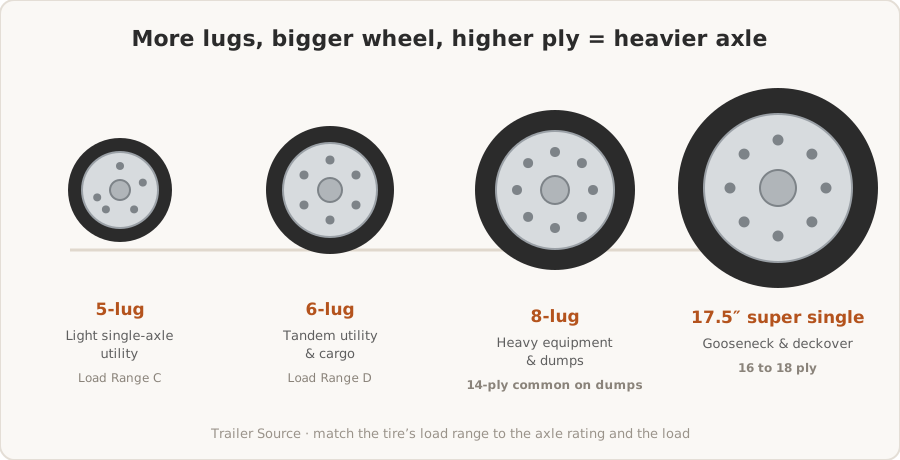
Lugs, wheel size, and ply all track the axle
Walk our lot and you'll see trailer wheels run a wide range, and it isn't random. The wheel and the tire are sized to the axle under them, the way the diagram up top lays out. A light single-axle utility trailer rides on 5-lug wheels. Step up to a tandem utility or a cargo trailer and you're usually on 6-lug. Heavier equipment haulers and dumps move to 8-lug hubs, because more lugs and a bigger hub carry more weight. The heaviest goosenecks and deckovers go all the way up to 17.5-inch "super single" wheels wearing 16 or 18-ply tires.
Ply is just the old way of saying load range, and it climbs right alongside the axle rating. 14-ply is the one to know on dump trailers. A dump carries dense, dead weight, gravel and dirt and busted concrete, sitting right over the axles, so the higher ply and load range hold up where a lighter tire would build heat and let go. If you're shopping dumps or heavy equipment trailers, don't let anybody put a Range D tire under a load that wants a 14-ply. Match the tire to the axle rating and the real weight you'll haul, same as everything else on this page.
Age matters more than tread
Here's the one that surprises people. Trailer tires almost never wear out. They age out. A trailer sits in the sun, loaded on one spot, for months at a time, and the rubber dry-rots from the inside while the tread still looks brand new. Find the DOT date code on the sidewall; the last four digits are the week and year, so "3120" is the 31st week of 2020.
Don't stretch it. Carlisle, one of the big trailer-tire makers, puts the average life of a trailer tire at three to five years, tells you to start thinking about replacement after three, and says to replace them by five regardless of how much tread is left (Carlisle, Trailer Tires: Tips & Best Practices). That's a lot more conservative than most people expect, and it's because ST tires sit still, bake in the UV, and carry a heavy static load the whole time. We pull plenty of tires with 90% tread and cracks running deep in the sidewall.

Two habits that save tires
Run them at the cold pressure on the sidewall, not "looks full." An underinflated ST tire builds heat, and heat is what blows them. And check them before a big haul, not during. A quick pressure check and a look for sidewall cracking in the driveway beats a jack on the interstate. If you're not sure what your trailer should be wearing, bring the old tire or the VIN plate to our parts counter and we'll match it right, or put a new set on and balance them while we're at it.
Ready to shop, or want us to handle it?
Come see us here in Greenville, browse what's on the lot right now, or let our service shop take care of the work.