Trailer axles: the questions we actually get asked
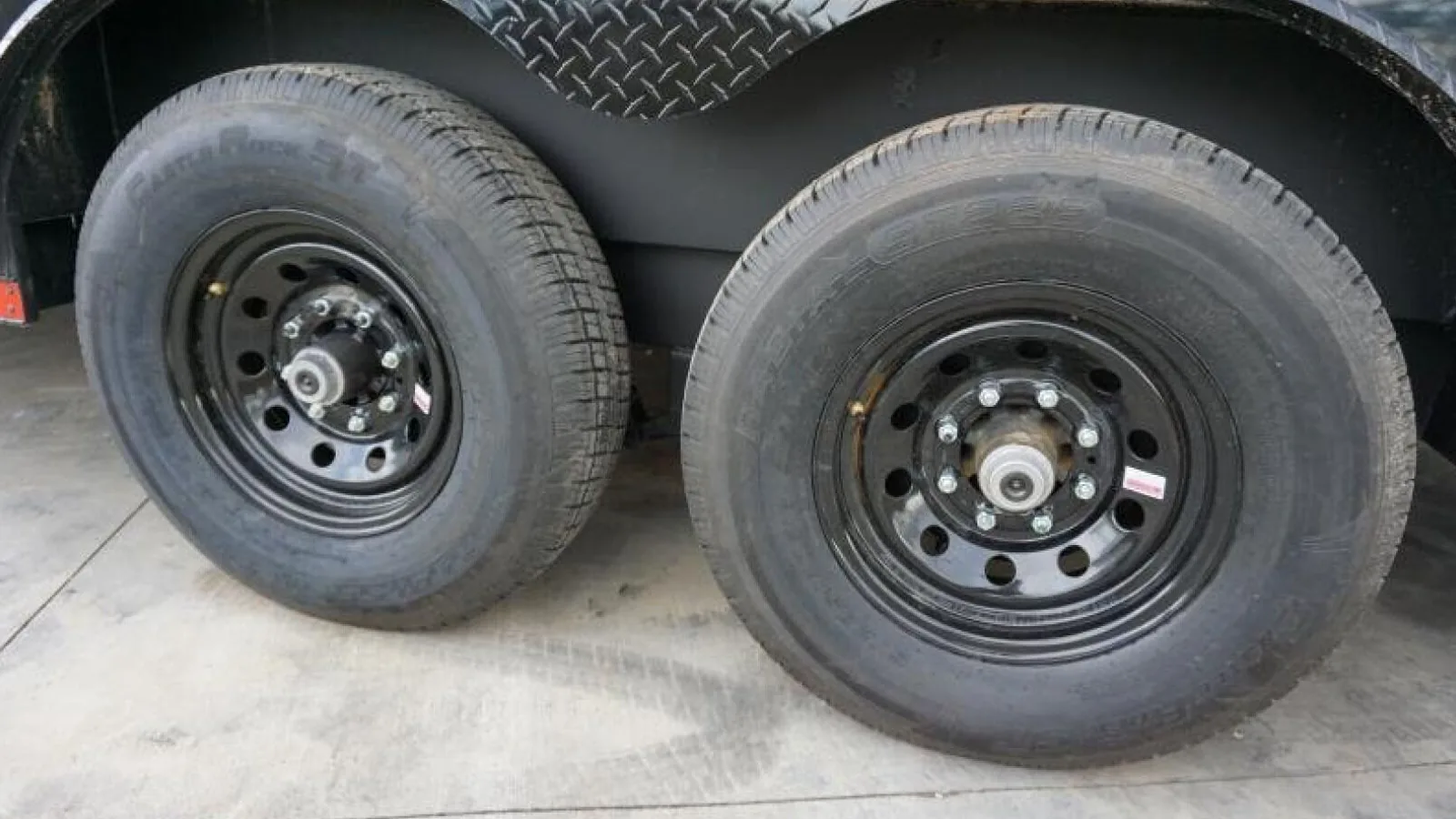
How to find the number on your axle, why the beam is bowed, what the warranty really covers, and whether torsion or leaf spring is the right thing under your trailer. Straight answers, no filler.
These are the axle questions we get asked across the counter, answered as directly as we can. We sell and service trailers, we do not build axles, so where an answer belongs to the manufacturer we say so and point you at their document rather than paraphrasing it into something vaguer.
How do I identify my axle?
Start on the axle beam itself. The maker puts an identifying number on it, and on a Dexter axle built after April 2001 that is a nine digit lot number stamped into the rear face of the beam, near the middle, under a Dexter Axle marking. Years of road grime hide it well. Lay a sheet of paper over it and rub across it with the side of a pencil or a piece of chalk, and the number usually comes up.
Lippert does it differently and prints the information on a label on the tube. We wrote a walk through on finding and decoding that label.
If the number is long gone, you are not stuck. The rating still lives on the trailer's VIN plate as the GAWR for each axle, and the measurements tell the rest of the story. Before you call anybody about parts, write down:
- Overall length, measured hub face to hub face.
- Spring center to spring center, the distance between where the axle sits on its mounts.
- The beam itself: round tube or square, and its size.
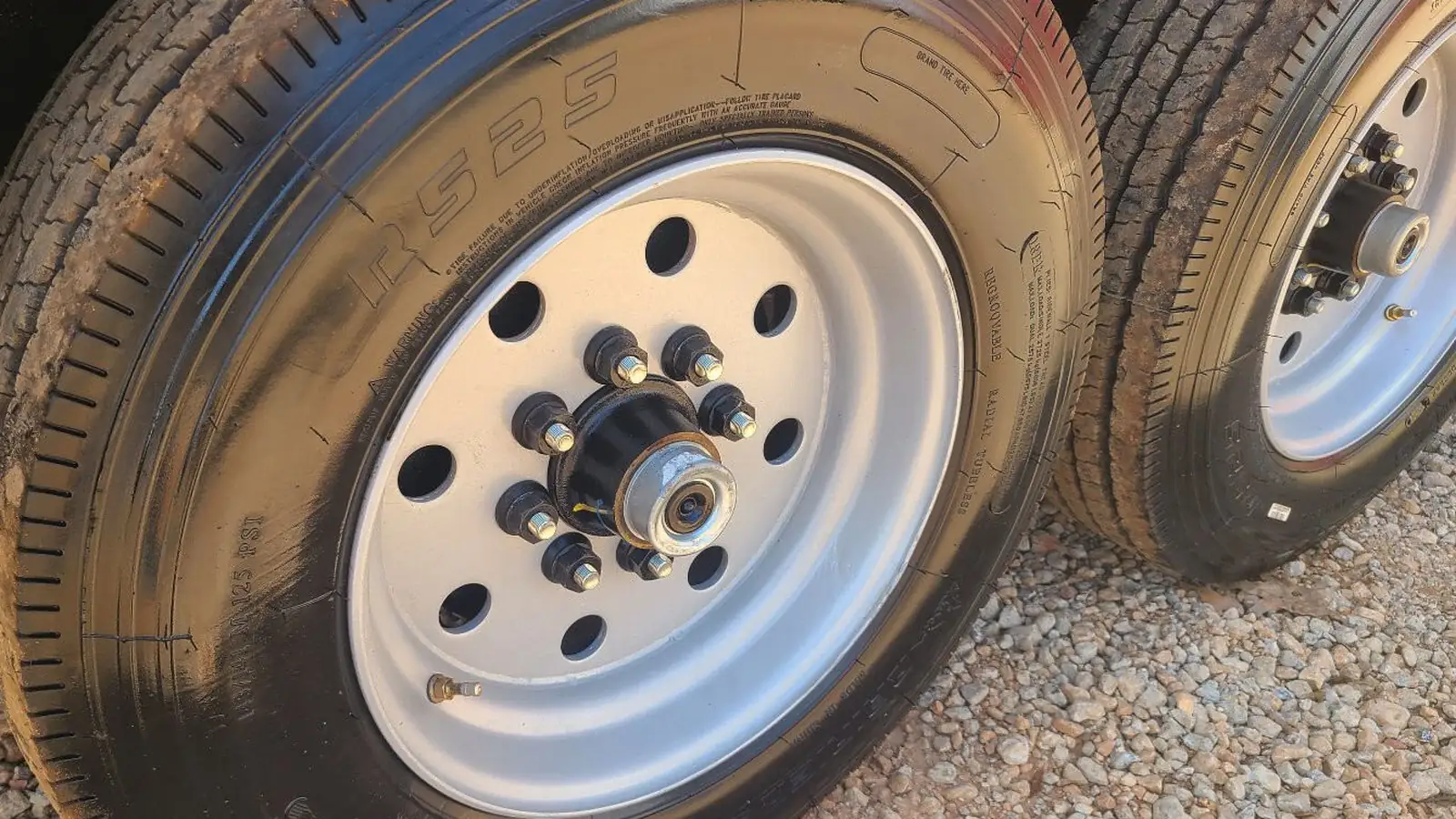
- The bolt pattern, meaning how many studs and the circle they sit on.
- Whether it has brakes, and if so whether they are electric or hydraulic.
- The GAWR from the VIN plate, and the trailer's GVWR while you are looking at it.
That same list is what a warranty claim needs, because the manufacturer will ask for the serial number before anything else happens.
Why are some axles bent in the middle?
Because they are supposed to be. That upward bow is camber, and it is built into the beam deliberately so the beam flattens out under load and the tires sit square on the road instead of leaning. Empty, you can often see the arc, and the tires can look slightly tilted. Loaded, it all straightens up. Nothing is wrong with it.
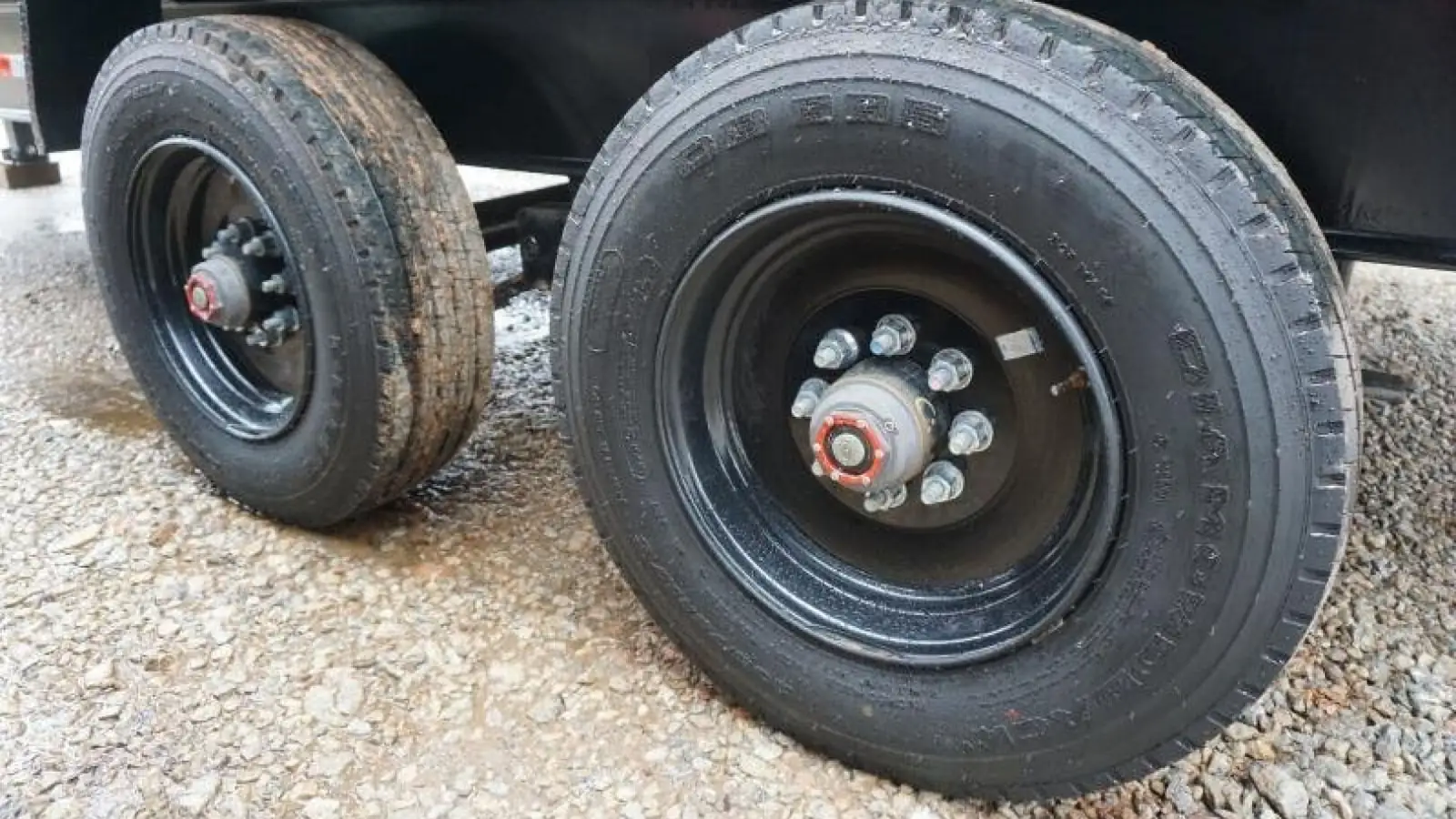
What is worth knowing is how to tell that from an axle that really is bent. Camber is symmetrical: the arc is even, both sides match, and the tires wear evenly across the tread. Damage from an overload or a hard curb strike usually is not. Look for one side sitting differently to the other, an uneven gap between a tire and its fender, wear concentrated on the inside or outside edge of one tire, or a trailer that tracks slightly off to one side behind the truck.
If any of that is happening, get it measured rather than guessed at. A bent axle is a replacement, not a straightening job, and heating or bending one to correct it takes the warranty with it.
Can mobile home axles be reused?
No. They turn up cheap and they look like a bargain under a homemade trailer, so it is worth understanding what you are actually buying.
A mobile home axle is engineered for one job, which is getting the home to the site. Dexter forges those spindles rather than precision grinding them, welds the brake assemblies to the beam so they cannot be swapped in the field, fits smaller bearings than a service axle gets, and does not sell replacement parts for them. When something wears out, and it will, there is nothing to put on it.
The paperwork agrees. Dexter's warranty leaves its 6000 series manufactured housing axles out entirely, and separately excludes any axle used on a unit other than the one it was originally mounted to. So there is nothing behind a reused one either way.
What warranty is on my axle?
Whatever the axle maker offers, not something we add on top. On Dexter axles built on or after September 1, 2016, their limited warranty runs five years on sprung axles, sprung suspension systems and Dexter genuine replacement parts, and ten years on the suspension components of a Torflex axle. Grease and oil seals are one year across the board. All of it runs from the date of the original retail purchase.
Three parts of it catch people out:
- It runs to the original purchaser and it does not transfer. If you bought the trailer used, the axle warranty did not come with it.
- Manufactured housing axles in the 6000 series are excluded.
- The exclusions are the ordinary ones and they are enforced: overloading, improper installation or alignment, wrong wheel nut torque, corrosion and cosmetic finish, parts that did not come from Dexter, and any alteration of the axle at all, welding brackets onto it included.
Those figures come from Dexter's own limited warranty document, LIT-400-00 Rev. P, dated June 2020, and we read it on 7 August 2026. It is linked in the sources at the bottom of this page. A manufacturer can revise a warranty whenever it likes, so check the current version before you rely on any of this. You will need the axle serial number to file a claim, which is the practical reason the first question on this page matters.
Our shop is an authorized service point for Dexter and Lippert and handles warranty and insurance repair work. Bring the trailer in, we will look at the axle and tell you honestly where you stand. Whether a claim is approved is the manufacturer's decision, not ours, and we would rather say that up front than have you hear it later.
Can an axle be used without a suspension?
It can be bolted straight to the frame, and Dexter's position is that doing it costs you at least half the rated capacity. A 3,500 pound axle hard mounted to a frame is not carrying 3,500 pounds.
The reason is simple enough. With no spring or rubber between the beam and the frame rails, every bump in the road goes straight into both of them. The ride is punishing, the cargo takes it, and the trailer takes it. It is not recommended, and it is one of the reasons a shop built trailer with good axles under it can still be rated far below the stamp on the beam. If you are trying to work out what a trailer can genuinely carry, we go through the math in our payload capacity guide.
Can I buy an axle straight from the manufacturer?
You can ask, but for one or two axles it is usually the slow and expensive way around.
Axle makers build to order rather than stock a shelf. Between length, capacity, brake type, spring seat placement and bolt pattern there are tens of thousands of combinations, so there is nothing finished sitting there waiting for you. On a single axle the setup and the freight swallow whatever you thought you were saving. Distributors buy in volume and keep bare beams on hand, which is why a one off axle almost always lands faster and cheaper through one of them.
That is the part we do. Our service department matches axles by capacity and spec, orders them and fits them, and we are an authorized service point for Dexter and Lippert. Turn up with the measurements from the first question and it is a short conversation. The everyday trailer parts that go with the job are here too.
Can I run three Torflex axles under one trailer?
Not standard Torflex axles. Torflex is Dexter's torsion axle line, and the thing that makes a torsion axle good on a tandem is exactly what rules it out on a triple. Each axle is fully independent, with no equalizer tying it to the one behind it, so nothing shares load between them.
On flat ground that is fine. Cross a steep driveway apron, a railroad crossing or a speed bump and the trailer pivots for a moment over the middle axle. With nothing to spread the weight, one axle can end up carrying far more than its share, and that is a straightforward overload on an axle that was rated assuming it would not happen.
Leaf spring triples get around this with equalizers between the axles. Dexter does build a Torflex series intended for triple axle work, and the ordinary ones are not it, so a triple has to be specified when the trailer or the axles are ordered rather than assembled out of what is on hand.
Can I weld to a Torflex axle or move the brackets?
No. The suspension inside that beam is rubber, and welding heat destroys it. You will not see the damage from the outside and the axle will not be the same afterwards.
Dexter's warranty says the same thing in writing: damage caused by or related to any alteration of the axle, welding supplemental brackets onto it included, is not covered. If the brackets are in the wrong place, the answer is the correct axle, not a torch. Bring it to the shop and we will work out what it should have been.
Can I change my Torflex start angle?
No. The start angle is the angle the torsion arm sits at with no load on it, and it sets where the hub ends up relative to the beam, which is another way of saying it sets your ride height. It is built into the axle. A different start angle is a different part number, not an adjustment you can make in a driveway, and not one we can make in the shop either.
So it is a decision that has to happen before the axle is ordered. If you need a particular deck height, or you need the trailer to sit level behind a lifted truck, tell us that at the start and we will spec it that way.
What are the advantages of Torflex over leaf spring axles?
Both are good axles and the right answer depends on the life the trailer is going to have. Here is each side of it honestly.
Torsion, in Torflex form:
- Each wheel moves on its own, so one wheel dropping into a hole does not lever the other one up.
- Rubber does the work instead of steel on steel, so it rides quieter and with less sway.
- There are no shackles, hangers, bushings or equalizers to wear out, because there are none fitted.
- The amount of rubber inside is matched to the capacity when the axle is built.
- Ride height can be set by choosing the start angle at order time.
- Ten years of coverage on the suspension components against five on a sprung axle.
Leaf spring, which is what a great many work trailers ride on:
- Parts are everywhere and they are cheap. A broken spring, a worn shackle or a tired equalizer is a same day repair at a sensible price.
- The equalizer shares load between axles on a tandem or a triple, which is the one thing torsion cannot do.
- Everything on it is serviceable. When the rubber in a torsion axle is finally finished you do not rebuild it, you replace the whole axle.
- You can find a replacement in a hurry, almost anywhere.
Roughly: a trailer that runs the highway carrying something that does not enjoy being shaken is a good case for torsion. A trailer that gets worked hard, sits outside and needs to be back on the road tomorrow is a good case for leaf spring. Both come through our shop, and if you tell us the work you have lined up we will tell you which one we would put under it.
Not sure what is under your trailer?
That is normal, and finding out is a five minute job. Get the number off the beam if it is readable, take the measurements above, and photograph the VIN plate while you are down there. If you would rather not crawl around underneath it, bring the trailer to us in Greenville and we will read it for you, check the bearings and the brakes while it is up on the lift, and tell you plainly whether you are looking at a repair or a replacement. For more on what the ratings themselves mean, start with our axle ratings guide, or just get in touch.
Sources
Resources
Guides and manuals you can open or save. We host every one of these ourselves, so the link keeps working.
-
PDFDexter Limited Warranty (LIT-400-00)
What Dexter covers on a new axle, for how long, and what voids it.
Dexter Axle · PDF, 59 KB
-
PDFLight Duty 600-8K Complete Service Manual (LIT-001-00)
The full service manual for 600 lb through 8,000 lb axles, including brake and bearing specs.
Dexter Axle · PDF, 1.7 MB
-
PDFMedium Duty 9-15K Complete Service Manual (LIT-006-00)
The same coverage for 9,000 lb through 15,000 lb axles on heavier equipment trailers.
Dexter Axle · PDF, 1.6 MB
Ready to shop, or want us to handle it?
Come see us here in Greenville, browse what's on the lot right now, or let our service shop take care of the work.
Would you rather we handle it?
Our shop here in Greenville does this work every day. Tell us what you need and we will get you a hand, or get the right part on order.