How to inspect a used trailer before you hand over cash
A used trailer can be a great buy or a rolling headache, and the difference is usually fifteen minutes with a flashlight. This is the walk-around we do before anything comes onto our lot.
Here's what the seller isn't going to point out: the trailer that photographs great in a parking lot can be somebody else's problem hiding under a fresh coat of rattle-can paint. Rust, a tweaked frame, dry-rotted tires, none of it shows up in the ad. Fifteen minutes with a flashlight and a floor jack is usually all it takes to tell an honest trailer from a patched-up one, and it's the same walk-around we run on every trade-in before it earns a spot on our own lot.
Bring gloves, a flashlight, and a pair of channel locks, and do it in daylight if you can. Take your time on the five things below and you'll catch nine out of ten bad ones.
1. The frame is the whole trailer
Almost everything structural on a trailer is welded, not bolted. The coupler, the cross-members, the spring hangers, the axle mounts, the frame rails themselves: it's all welded steel. You don't unbolt a bent cross-member and slide a fresh one in. A shop has to cut the old steel out and weld new steel back in, and a sloppy prior repair can leave the whole trailer tracking crooked for good. That's exactly why the welds and the frame are the first thing we look at, and why they matter so much more than the stuff that just bolts on.
Get under it and look at the main rails and the cross-members where they meet the frame. That's where cracks start. Surface rust that flakes off to solid steel is normal on an older utility trailer. Rust you can push a screwdriver through is not. Look hard at every weld. A cracked weld at the tongue, or a coupler that's been re-welded twice, tells you this trailer has been overloaded or hit.
2. Floor and walls
On a wood-deck utility trailer, stand on every board and lean into them. Soft, gray, or springy wood means water's been sitting in it, and rotten deck boards often mean rotten frame underneath. On an enclosed cargo trailer, check the lower corners and the door frame for delamination, and look up at the roof seams. Push on the walls; luan that's separating from the frame will oil-can and flex.

3. Tires tell the truth
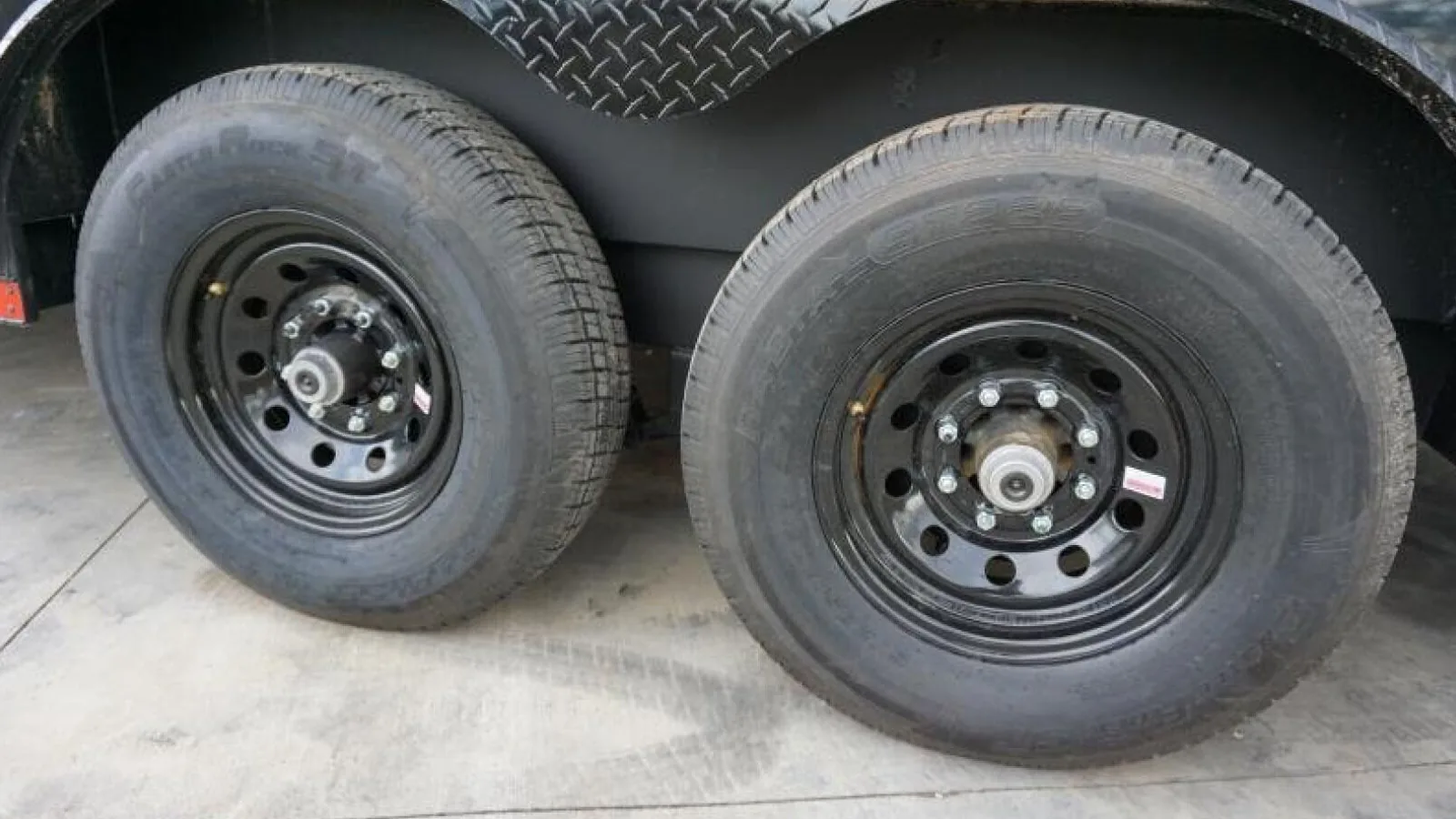
Tread depth is the least of it. Find the DOT date code on the sidewall. The last four digits are the week and year it was built, so "2419" means the 24th week of 2019. A trailer tire ages out long before the tread wears out, because it sits in the sun on one spot for months and dry-rots from the inside. Carlisle, one of the big trailer-tire makers, calls three to five years the average life and says to replace them by five regardless of tread. So anything past about five years, or showing sidewall cracking, gets replaced no matter how deep the tread looks. Two mismatched brands or sizes is a red flag that somebody was replacing blowouts one at a time.
4. Bearings, brakes, and suspension
Jack up one wheel at a time. Spin it. You should hear nothing but a light whir. Grinding or growling is a bad bearing. Grab the tire at 12 and 6 and rock it; real play means a loose or worn bearing. While you're under there, eyeball the leaf springs, shackles, and U-bolts for cracks and heavy rust, and check that the axle looks straight. If it's got electric brakes, ask for a plug-in and feel each wheel drag when the controller's applied.
5. Paperwork and the numbers
Find the VIN plate first. It's usually stamped on the tongue or the front frame rail. Whatever the seller hands you, the numbers have to match that plate, and the name on the paperwork has to match the person you're actually buying from. Proof of ownership is the whole game here.
Now, South Carolina is its own animal on this. A privately owned utility trailer you're not running for hire doesn't have to be registered or tagged to use in-state, so plenty of small trailers change hands here on nothing but a bill of sale. Heavier trailers are a different story: once empty weight hits 2,500 pounds, and for campers and travel trailers, the SCDMV does require a title and registration. For any trailer that does need a title, no title in hand is a real problem. It means a bonded-title headache or worse, so either knock the price way down and go in with your eyes open, or walk. Not sure which bucket your trailer falls in? The SCDMV camper and trailer page spells it out.
The quick gut check
Hook it up and pull it around the block if you can. Watch for a trailer that tracks crooked or a wheel that wanders. That's a bent axle or a sprung frame. Check that all the lights work before you leave the driveway.
Not sure what you're looking at? Bring it by our shop for a once-over before you buy, or skip the guesswork and shop our reconditioned inventory. Everything we sell gets this same inspection first.
Ready to shop, or want us to handle it?
Come see us here in Greenville, browse what's on the lot right now, or let our service shop take care of the work.