No trailer lights? Here's how we track it down
Nine times out of ten a dead trailer light is a bad ground, not a bad bulb. Work the connector, work the ground, and you will fix most wiring problems in the driveway.
On this page, 5 sections
Trailer lights always seem to quit on a Friday afternoon when you're already loaded and running late. Before you start yanking wires out of the harness, it helps to know how a trailer is grounded: it grounds through its own steel frame, and that connection corrodes, loosens, and gets painted over. Far more dead lights trace back to that one tired ground than to any burned-out bulb, so clean it up first and most of the trouble disappears.
Grab a cheap circuit tester or a multimeter before you start. You can chase this whole thing without one, but a $10 test light turns guessing into knowing.
Rather not chase it yourself? Wiring gremlins can eat a whole afternoon. Our shop traces them every week and knows the usual suspects cold, so if you'd rather just get it fixed right the first time and not think about it on the highway, send us a service request and we'll sort it out.
Know your wires
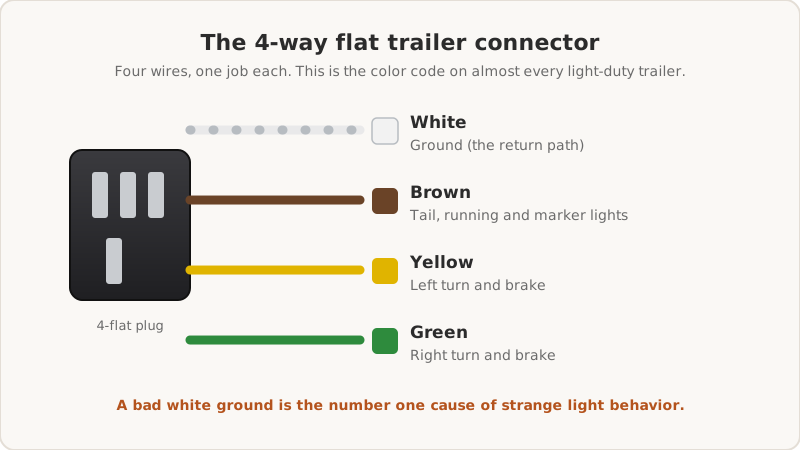
Most utility and small cargo trailers use a 4-pin flat connector. The color code is standard:
- White: ground
- Brown: running, tail, and marker lights
- Yellow: left turn and brake
- Green: right turn and brake
Bigger trailers with electric brakes run a 7-way, which adds brake, 12V, and reverse, but the lighting logic is the same. Learn those four colors and you can diagnose almost anything.
Why the colors don't always match
Here's the catch nobody tells you about. That color code above is the RV/RVIA standard, but there's also a separate SAE/automotive color code that runs different colors for the same functions. Both are "correct," they're just two different standards. On top of that, a lot of trailer builders don't wire to either one consistently. Somebody on the line grabbed whatever spool of wire was on the bench that day, and what you end up with under the frame doesn't match any chart. We see it all the time on the bench.
When the colors don't add up, stop guessing and go get a power probe, a powered circuit tester that lets you put power to a wire instead of just checking for continuity. Clip it to a wire at the connector and follow it back to the light, and you'll know exactly where that wire goes and what it's actually doing, no matter what color it happens to be. It turns a frustrating hour of tracing wire under the trailer into a five-minute job, and it's the one tool that saves us the most time when a harness doesn't play by the rules.
Start at the connector
Pull the plug apart and look at it. Corroded green pins, a bent blade, road grime packed in the plug: that alone kills more lights than anything else. Clean the pins with a small brush, hit them with dielectric grease, and try again. With the truck running and a helper working the turn signals and brakes, back-probe each pin with the tester against a good ground. Getting power at the plug but no light out back? The problem's on the trailer. No power at the plug? Now it's the truck side, so check the truck's fuse and its own connector.
Chase the ground first
If one function is dead but you've got power at the connector, find the ground. It's usually a white wire bolted to the frame near the tongue or a taillight. Undo it, sand the frame down to bare shiny metal, and bolt it back tight. That single step fixes a shocking number of "dead" trailers. A telltale sign of a bad ground is lights that do something weird: the tail lights flicker when you hit the turn signal, or the left blinker makes the right marker glow. Backwards, cross-talking lights are almost always grounding through a circuit they shouldn't, because the real ground is gone.
Bulbs, sockets, and LEDs
If a single light is out and everything else works, now it's worth pulling that lens. Incandescent bulbs blow and sockets corrode, and a wire brush and fresh dielectric grease bring a lot of them back. Honestly, if you're already in there, swap the old incandescent housings for sealed LED units. They pull less current, they don't have a filament to shake loose on a washboard road, and a good sealed LED just doesn't let water in. We keep them on the shelf at the parts counter.
When to hand it off
Some jobs aren't worth an afternoon in the driveway. If the harness is chewed up under the trailer, cracked and brittle from age, or somebody's already been in there with a roll of electrical tape and crimps that fell apart, a full re-wire is cheap insurance and it'll be right. Bring it in and we'll pull new wire, seal every connection, and you won't be chasing this again next spring.
Ready to shop, or want us to handle it?
Come see us here in Greenville, browse what's on the lot right now, or let our service shop take care of the work.