Do you need trailer brakes in South Carolina? The law, and how the brakes work
South Carolina says any trailer over 3,000 pounds needs brakes on all wheels, plus a breakaway that holds for fifteen minutes. Here is the law in plain English and how the brake types compare.
Whether your trailer is legally required to have brakes in South Carolina comes down to one number and one exception, and both are written into state law. Get this wrong and you are not just unsafe, you are ticketable. Get it right and you know exactly what your trailer needs before you ever hit the highway.
What South Carolina law actually says
The rules live in the South Carolina Code of Laws, Title 56, Chapter 5, Section 56-5-4850 (Justia, LawServer). Two provisions do the heavy lifting.
Over 3,000 pounds, you need brakes on all wheels. Every trailer, semitrailer, or pole trailer with a gross weight over 3,000 pounds must be equipped with brakes acting on all wheels. Gross weight here means the loaded weight, not the empty weight, so a light trailer that you load heavy can cross the line.
The 3,000 pound exemption, with a catch. A trailer at or under 3,000 pounds gross does not need brakes, but only if the total weight on its wheels does not exceed 40 percent of the gross weight of the towing vehicle when they are hooked together. In plain terms, a small trailer behind a heavy truck can skip brakes; the same small trailer behind a light car may not. The heavier your tow vehicle relative to the trailer, the more slack the law gives you.
Breakaway is required on braked trailers. When a trailer has brakes because it is over that threshold, the brakes have to be built so that if the trailer comes loose from the tow vehicle, they apply automatically and promptly and stay applied for at least fifteen minutes. That is the job of the breakaway system: a small battery on the trailer and a pull pin tethered to your truck. If the trailer separates, the pin yanks out and the battery slams the brakes on.
Your tow vehicle has to be ready too. Any tow vehicle built after July 1, 1964 that pulls a braked trailer must be able to stop itself with its own service brakes if the trailer breaks away. That is standard on modern vehicles, but it is in the law.
South Carolina does not require a separate safety inspection for most private trailers, but these equipment rules apply on the road regardless. And no matter the trailer's weight, the state also requires safety chains or cables connecting the trailer to the tow vehicle, in addition to the hitch, strong enough to hold the trailer under all conditions (SC Code 56-5-5150). Cross them under the tongue so a dropped coupler lands in the chains, not on the pavement.
A quick reference
| Loaded trailer weight | Brakes required in SC? |
|---|---|
| Over 3,000 lb | Yes, on all wheels, plus breakaway |
| 3,000 lb or less, wheel load over 40% of tow vehicle weight | Yes |
| 3,000 lb or less, wheel load 40% or under of tow vehicle weight | No |
Registration is a separate question from brakes, and it has its own weight rule. We cover when a South Carolina trailer needs a title and tag in our South Carolina registration guide.
The two brake systems you will see
If your trailer needs brakes, it will almost always have one of two types.
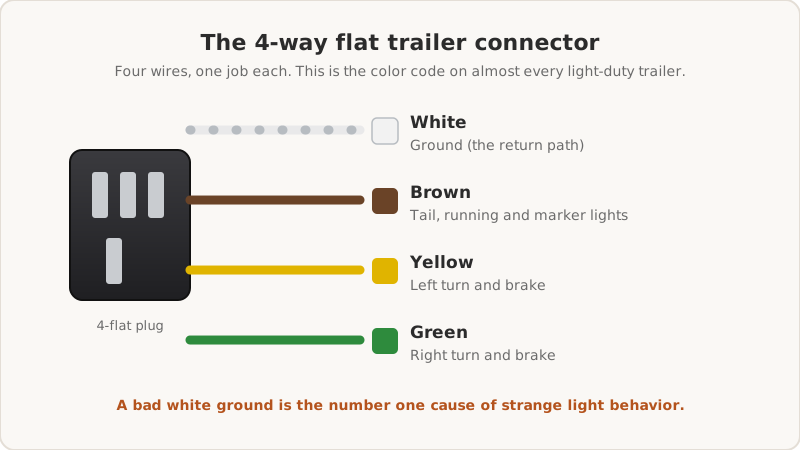
Electric brakes are by far the most common on the trailers we sell and service. A brake controller in your tow vehicle sends current back to an electromagnet in each hub, which grabs a drum and slows the wheel. You control the strength, you can apply the trailer brakes by hand to settle a sway, and they play nicely with a breakaway battery. The weakness is the wiring. Electric brakes live and die by clean grounds and correctly sized wire, and an undersized wire run is the single most common reason brakes feel weak. We dug into that in our guide to electric brake wire gauge.
Surge (hydraulic) brakes need no controller and no wiring to the tow vehicle. A coupler mechanism senses the push of the trailer against the ball when you slow down and uses that force to apply hydraulic brakes. You see these on rental trailers and boat trailers, where the coupler and its dunking in salt water make electric wiring a headache. The tradeoff is you cannot apply them independently, and they can feel grabby on grades.
A third type, electric over hydraulic, blends the two: an electric controller signal triggers a hydraulic pump for strong, smooth stops on heavy trailers. It shows up on big equipment haulers and goosenecks, and it is more complex to service.
Where brakes fail, and where to stop guessing
Trailer brakes fail quietly. You do not notice a dead magnet or a corroded ground until you need to stop hard and the truck does all the work. Common culprits are a bad ground, thin or corroded wiring, a worn magnet, an out of adjustment drum, or a breakaway battery that has been dead for a year.
Some of this is checkable in the driveway. Plug in, have someone apply the controller, and feel each wheel for drag. A wheel that stays free when the others grab has a wiring or magnet problem on that hub. Testing the breakaway is as simple as pulling the pin with the trailer chocked and confirming the wheels lock.
The fixes past that point, replacing magnets, turning or swapping drums, chasing a wiring fault through a harness, refreshing a breakaway system, are shop work. Brakes are the one system where a wrong guess ends with a trailer that will not stop, so this is not the place to learn on the job. Bring it to our service shop and we will test the whole circuit, adjust or replace what is worn, and confirm your breakaway actually holds. If you just need parts, our parts counter carries magnets, drums, controllers, and breakaway kits, and we will make sure you leave with the right ones.
Buying a heavier trailer that will need brakes from day one? Every dump and equipment hauler on our lot comes set up to meet these rules. Have a look at the dump trailers.
Sources
Ready to shop, or want us to handle it?
Come see us here in Greenville, browse what's on the lot right now, or let our service shop take care of the work.